Wabi-Sabi Living: The Art of Imperfection (2026 Guide)
Contents
- 1 Wabi-Sabi Living: The Art of Imperfection (2026 Guide)
- 1.1 Introduction: Why Wabi-Sabi Still Matters in 2026
- 1.2 Origins & Meaning: Wabi-Sabi The Philosophy of Imperfection
- 1.3 Modern Interpretation: From Japanese Aesthetics to Interior Design
- 1.4 Core Principles: Simplicity, Naturalness, Imperfection
- 1.5 Visual Guide: Wabi-Sabi vs Japandi (Understanding the Distinction)
- 1.6 Integrating Wabi-Sabi Into Daily Life & Interiors
- 1.7 Practical Implementation: Moving from Theory to Reality
- 1.8 Deep Dive: The Psychology of Wabi-Sabi Environments
- 1.9 Wabi-Sabi and Sustainability: The Natural Alignment
- 1.10 Conclusion: Living the Philosophy
wabi-sabi – How ancient Japanese philosophy creates sanctuary in our overstimulated digital age
Introduction: Why Wabi-Sabi Still Matters in 2026
We live in an era of algorithmic perfection. Our social feeds curate flawless interiors. Our shopping carts overflow with mass-produced furniture designed to look like everyone else’s. And somewhere in this pursuit of the picture-perfect home, we’ve lost something essential: the ability to feel at peace in our own spaces.
This is where wabi-sabi offers not just an aesthetic alternative, but a philosophical antidote.
While minimalism has dominated the 2010s and 2020s design conversation, wabi-sabi goes deeper. Where minimalism can feel cold and austere, wabi-sabi embraces warmth through texture. Where minimalism pursues perfection through reduction, wabi-sabi finds beauty in the weathered, the handmade, the slightly askew. It’s not about creating an empty space—it’s about creating a meaningful one.
In 2026, as we collectively grapple with digital overwhelm, climate anxiety, and the exhaustion of constant curation, wabi-sabi’s 16th-century wisdom has never been more relevant. This isn’t a trend returning for its moment in the spotlight. This is a fundamental reorientation toward what makes a house feel like a sanctuary.
This guide will take you beyond the superficial “rustic bowl on linen” aesthetic you’ve seen everywhere. We’ll explore the psychological foundations of why wabi-sabi creates calm, the practical principles for applying it to real homes with real lives, and how to distinguish authentic wabi-sabi design from its many imitators.
Wabi sabi cta block · HTML CopyShop Our Wabi-Sabi Home Edit
Every piece chosen for its natural materials, handmade character, and honest imperfection. Ceramics, linen, rattan lighting, and more — curated to bring calm into every room.
Explore the collection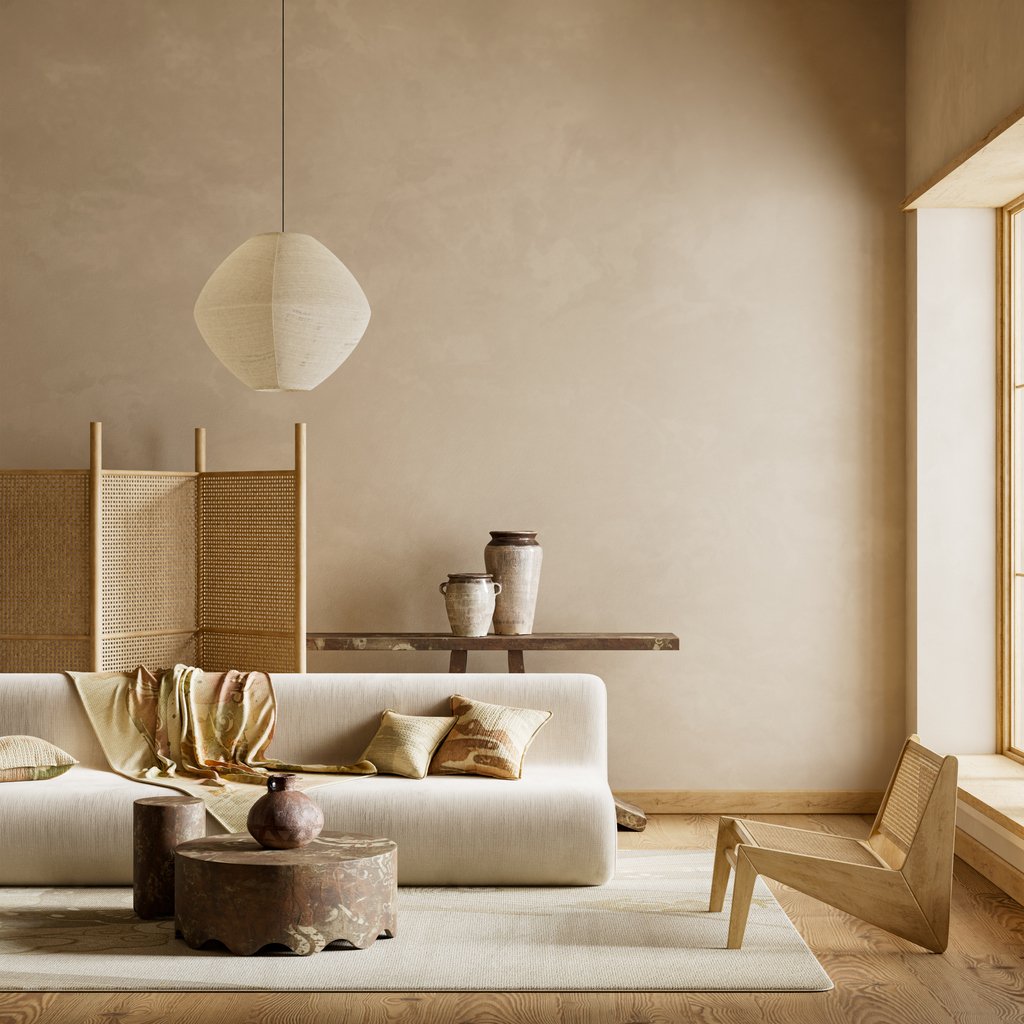
Origins & Meaning: Wabi-Sabi The Philosophy of Imperfection
The Tea Ceremony Revolution
Wabi-sabi emerged in 16th-century Japan, but not as an interior design movement. It was a philosophical rebellion.
At the time, Japanese tea ceremonies were elaborate affairs showcasing Chinese porcelain, imported treasures, and ostentatious displays of wealth. Then came Sen no Rikyū, the tea master who would change everything. Rikyū stripped away the pretense. He served tea in rough, irregular Korean peasant bowls. built tea houses from humble materials. designed spaces so small that samurai had to leave their swords outside, equalizing all who entered.
This wasn’t poverty aesthetics—it was intentional simplicity as a path to presence.
The Etymology That Reveals Everything
The term “wabi-sabi” combines two distinct but complementary concepts:
Wabi originally meant the loneliness of living in nature, remote from society. Over centuries, it evolved to represent simplicity, quietness, and the beauty found in modest, unadorned things. Wabi is the active choice to step back from excess.
Sabi referred to the beauty that comes with age—the patina on copper, the worn grain in floorboards, the way white walls develop character over time. Sabi is acceptance of the natural cycle of growth and decay.
Together, wabi-sabi describes a worldview that finds beauty in impermanence, imperfection, and incompleteness. It’s not about making things look old or distressed. It’s about honoring the honest marks of time and use.
The Three Core Truths of wabi-sabi
Wabi-sabi rests on three Buddhist principles that explain why it creates such profound calm:
- Nothing is permanent (Mujō) – Everything is in flux, constantly changing. Fighting this creates suffering; accepting it creates peace.
- Nothing is complete (Fukanzen) – Perfection is an illusion. The incomplete holds more beauty because it’s honest.
- Nothing is perfect (Fuzen) – Flaws are not failures to be hidden but expressions of uniqueness to be appreciated.
These aren’t decorating tips. They’re philosophical foundations that, when embodied in your physical space, change how you experience daily life. A home designed around these truths doesn’t demand constant maintenance, constant upgrade, constant performance. It breathes.
Modern Interpretation: From Japanese Aesthetics to Interior Design
The Cultural Translation Challenge
Here’s where most wabi-sabi content gets it wrong: it treats wabi-sabi as a style to copy rather than a principle to adapt.
You cannot simply transplant a 16th-century Japanese tea house aesthetic into a 21st-century Western home and call it wabi-sabi. The materials are different. The light is different. The cultural context is entirely different. A rural Japanese aesthetic that developed in wood-and-paper architecture doesn’t automatically translate to brick townhouses or suburban ranch homes.
Authentic wabi-sabi in 2026 requires understanding the why behind the aesthetic choices, then applying those principles to your context, your climate, your life and your wabi sabi products.
Interestingly, Scandinavian design has become an unexpected bridge for Western audiences to access wabi-sabi principles. Both traditions share:
- Respect for natural materials and their honest expression
- Emphasis on functionality and purposeful design
- Appreciation for craftsmanship over ornamentation
- Use of neutral, earth-derived color palettes
- Comfort created through texture rather than pattern
The key difference: Scandinavian design still pursues refinement and precision, while wabi-sabi actively welcomes irregularity. A Scandinavian chair is perfectly crafted. A wabi-sabi chair might have visible joinery, slight asymmetry, or an intentionally rough finish that shows the maker’s hand. this is the same for wabi-sabi wall art the point it to give life to structure through irregularity
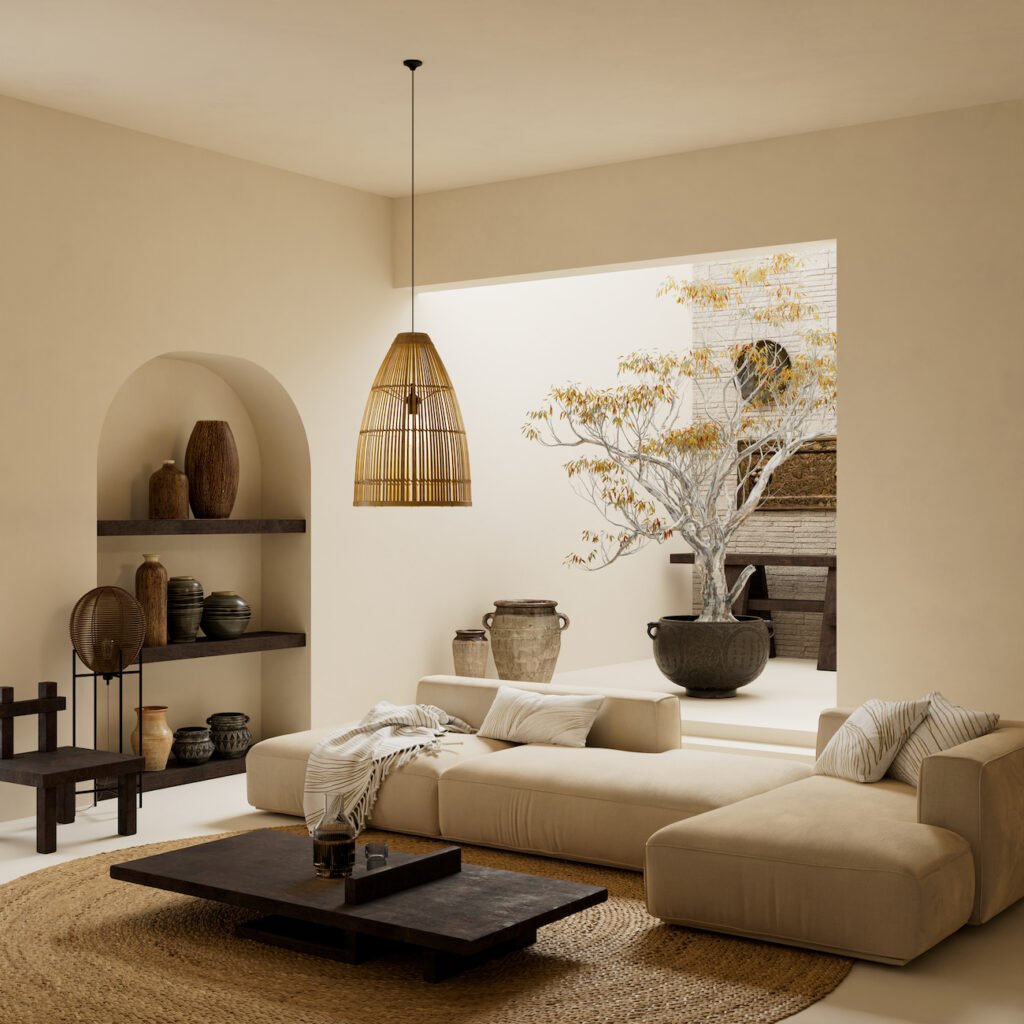
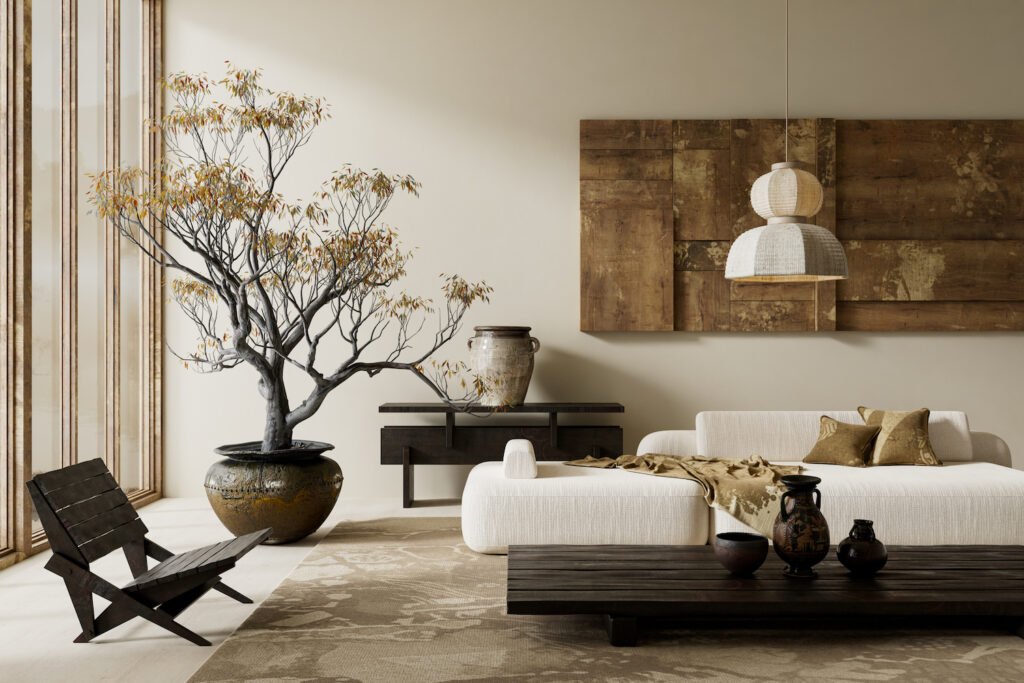
Minimal japandi living room design with warm wood textures, soft natural lighting and balanced composition that reflects modern interior trends and serene living spaces. 3D illustration
Wabi-Sabi in Contemporary Context
Modern wabi-sabi interpretation manifests through:
Material honesty – Using plaster that shows trowel marks, concrete that reveals aggregate, wood that shows knots and grain variation. Not distressing materials artificially, but choosing materials that reveal their true nature.
Patina as narrative – Allowing copper to oxidize, brass to tarnish, leather to scratch. Each mark tells the story of use, transforming objects from commodities into companions.
Textural warmth – Layering rough with smooth, matte with subtle sheen, hard with soft. This creates visual interest without relying on color or pattern.
Intentional restraint – Fewer objects, but each chosen for meaning or function. The opposite of the curated Instagram shelf where every object is positioned for likes.
Imperfect geometries – Handmade ceramics with irregular edges, woven textiles with slight variations, vintage pieces that don’t quite match. The irregularity signals humanity in an age of algorithmic precision.
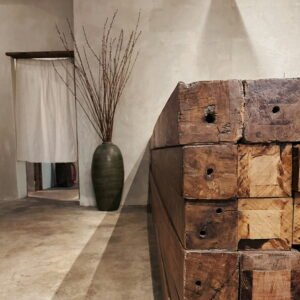
Core Principles: Simplicity, Naturalness, Imperfection
Principle 1: Simplicity (But Not Emptiness)
Wabi-sabi simplicity differs fundamentally from minimalist reduction.
Minimalism asks: “What can I remove?” Wabi-sabi asks: “What is essential?” The distinction matters enormously.
A minimalist might eliminate all books to achieve clean surfaces. A wabi-sabi approach keeps the well-worn books that are actually read, displayed on simple shelving that acknowledges their presence as part of a lived life.
In practice:
- Clear surfaces not for aesthetic purity, but to create visual rest and mental space
- Store items you use seasonally or rarely, rather than displaying them
- Choose furniture with simple forms that don’t compete for attention
- Edit collections to only include pieces that maintain emotional resonance
- Allow empty space to exist as a design element itself, not as a void to fill
The goal is simplicity that creates calm, not simplicity that creates sterility.
Principle 2: Naturalness (Organic Materials and Honest Expression)
Wabi-sabi insists on materials that age rather than deteriorate, that gain character rather than looking worn out.
Priority materials:
Clay and earth – Unglazed ceramics, terracotta, raw plaster, lime wash. Materials that remain connected to their geological origin while serving human purpose.
Wood – Untreated or naturally oiled, showing grain and natural variation. Avoid overly uniform wood products or plastic laminates pretending to be wood.
Stone – Untreated marble, raw granite, river rocks. Materials that have existed for millennia and will outlast our lifetimes.
Natural fibers – Linen that wrinkles, wool that pills slightly, cotton that softens with washing. Textiles that improve through use rather than degrade.
Metals that patina – Copper, brass, bronze, iron. Metals that develop living surfaces that change with exposure to air and touch.
Why this matters psychologically:
Natural materials connect us to systems larger and slower than ourselves. When you touch a linen pillowcase or a wooden table, you’re engaging with materials that respond to human presence—they warm to your touch, they absorb your daily interactions, they age alongside you. This creates what researchers call “material intimacy,” the sense that your environment is alive and responsive rather than inert and mass-produced.
Synthetic materials—plastics, laminates, polyesters—don’t age, they deteriorate. They go from new to trash without the middle phase of character development. They keep us in a constant cycle of replacement rather than relationship.
Principle 3: Imperfection (Character Over Consistency)
This is where wabi-sabi becomes truly countercultural in 2025.
We’re surrounded by algorithmic perfection. Instagram filters. Photoshop. AI-generated images that are “perfect” but somehow hollow. Mass-produced furniture with computer-precision uniformity. We’ve become so accustomed to machine perfection that handmade objects can look wrong to our eyes at first.
Wabi-sabi recalibrates our aesthetic perception.
The beauty of imperfection manifests as:
Asymmetry – A handmade bowl that’s slightly oval rather than perfectly round. A gallery wall where frames don’t align to a grid. Furniture arrangements that respond to the room’s natural flow rather than forced symmetry.
Irregularity – Plaster walls with subtle texture variations. Handwoven textiles with slight pattern shifts. Wood furniture where pieces don’t exactly match.
Incompleteness – Shelving that stops before the corner. Wall treatments that don’t extend to every surface. Negative space that’s intentionally preserved rather than filled.
Marks of time and use – The worn spot on a wooden stair tread. The patina on a brass door handle. The faded portion of a rug near the window. These aren’t damages to hide—they’re the autobiography of your space.
Why imperfection creates calm:
Perfection is exhausting to maintain. When your home aesthetic demands flawlessness, you’re in constant battle with entropy. You can’t relax because relaxing creates disorder. Children and pets become threats to your environment rather than members of your household.
Imperfection gives you permission to live. When your aesthetic already embraces the marks of use, you’re no longer fighting against life—you’re designing for life.
Visual Guide: Wabi-Sabi vs Japandi (Understanding the Distinction)
The Confusion Problem
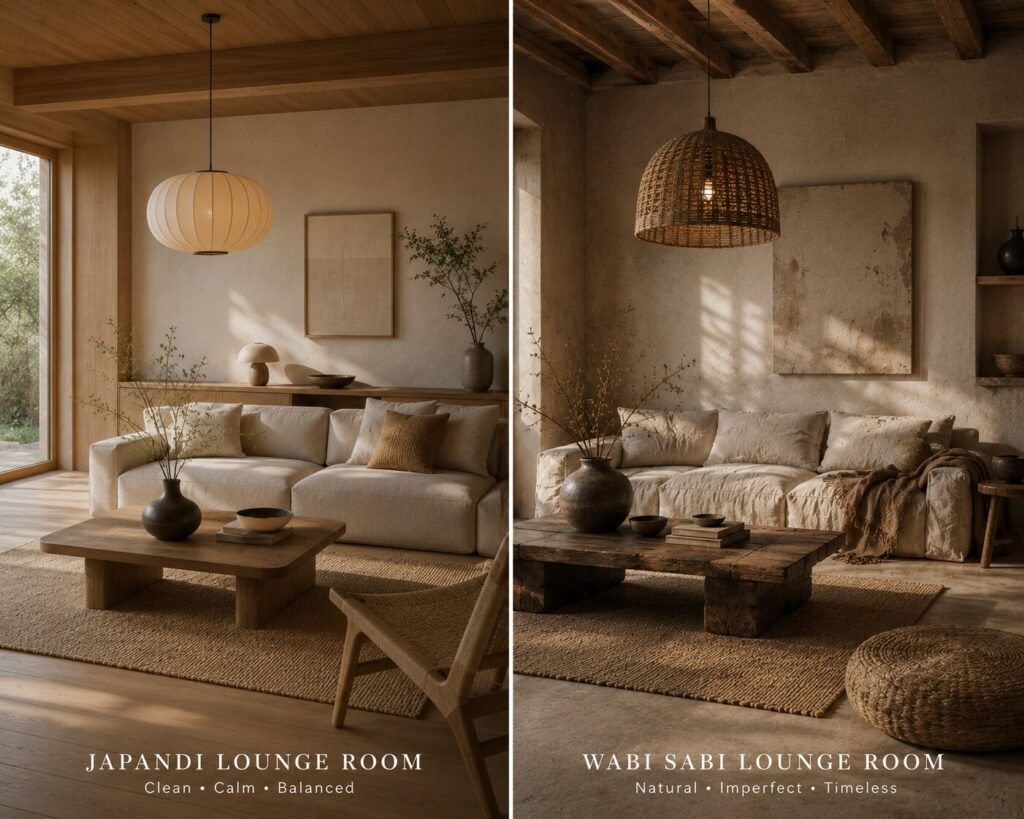
As wabi-sabi has entered mainstream design consciousness, it’s often conflated with “Japandi”—the hybrid of Japanese and Scandinavian design that became Instagram-famous in the late 2010s. While related, they’re fundamentally different approaches.
Understanding this distinction helps you make design choices that align with wabi-sabi’s philosophical foundations rather than just copying its surface aesthetic.
Japandi: The Refined Hybrid
Characteristics:
- Clean lines and precise geometry
- Carefully curated neutral palettes (grays, whites, muted tones)
- High-quality materials with refined finishes
- Intentional negative space as design, also features styling for modern smaller spaces
- Subtle contrast through texture
- Everything photographable and Instagram-ready
- Controlled, composed, elegant
Philosophy: Japandi pursues tranquility through refinement. It’s about creating beauty through careful selection and flawless execution. Every element is intentional, edited, considered. The result is undeniably beautiful but maintains a certain formality.
Wabi-Sabi: The Unrefined Original
Characteristics:
- Irregular forms and organic asymmetry
- Earth-derived colors with variation (ochres, umbers, stone)
- Raw materials with visible imperfections
- Patina and evidence of age valued
- Textural contrast through rough and smooth
- Handmade quality that shows the maker’s hand
- Comfortable, lived-in, soulful
Philosophy: Wabi-sabi pursues tranquility through acceptance. It’s about finding beauty that already exists rather than creating it through control. Elements have history, imperfection, authenticity. The result is deeply calming because it doesn’t demand anything of you.
Side-by-Side Comparison
| Element | Japandi | Wabi-Sabi |
| Color palette | Carefully curated neutrals | Earth tones with natural variation |
| Materials | High-quality, refined finish | Raw, honest, showing age |
| Furniture | Clean lines, perfect execution | Simple forms, visible joinery |
| Styling | Minimal, precisely placed | Fewer objects, casually arranged |
| Perfection | Pursued through precision | Released through acceptance |
| Feeling | Elegant calm | Grounded ease |
| Maintenance | Requires vigilance | Welcomes lived-in character |
The Practical Difference in Your Home
Japandi kitchen: Seamless white oak cabinets with concealed hinges. Matte white countertops without visible seams. Perfectly aligned open shelving with matching ceramic vessels. One sculptural fruit bowl as the only counter object. For japandi enthusiasts we cover everything from japandi living rooms and the best japandi furniture
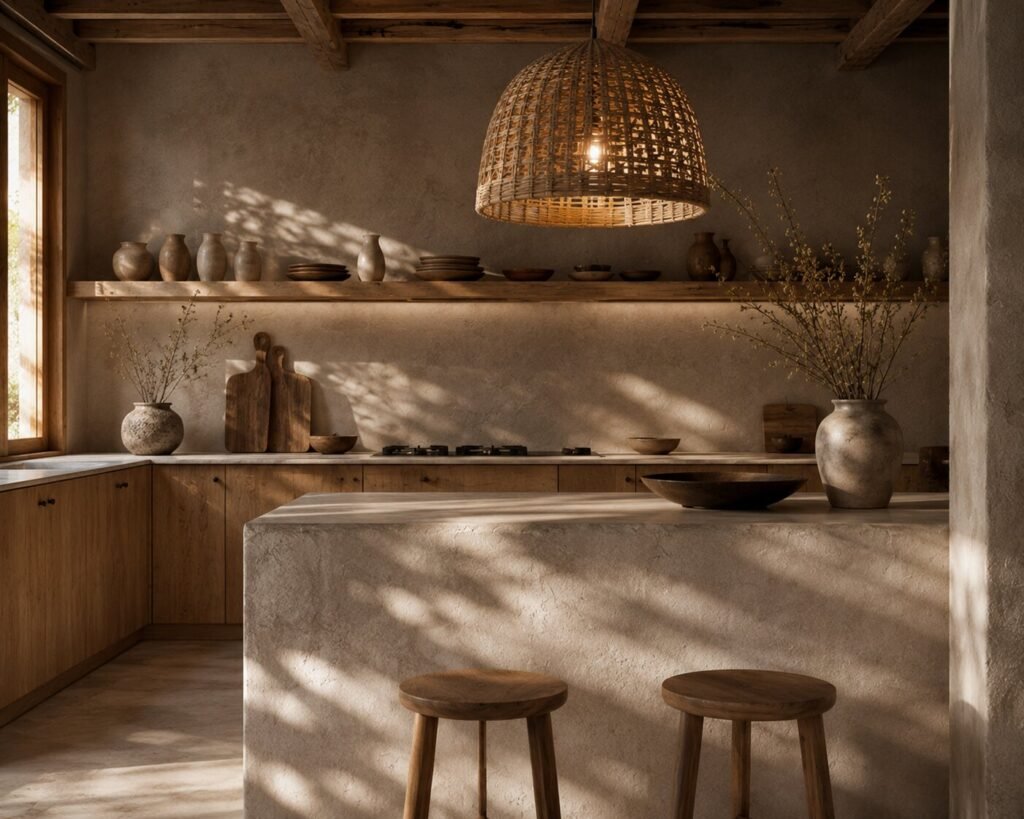
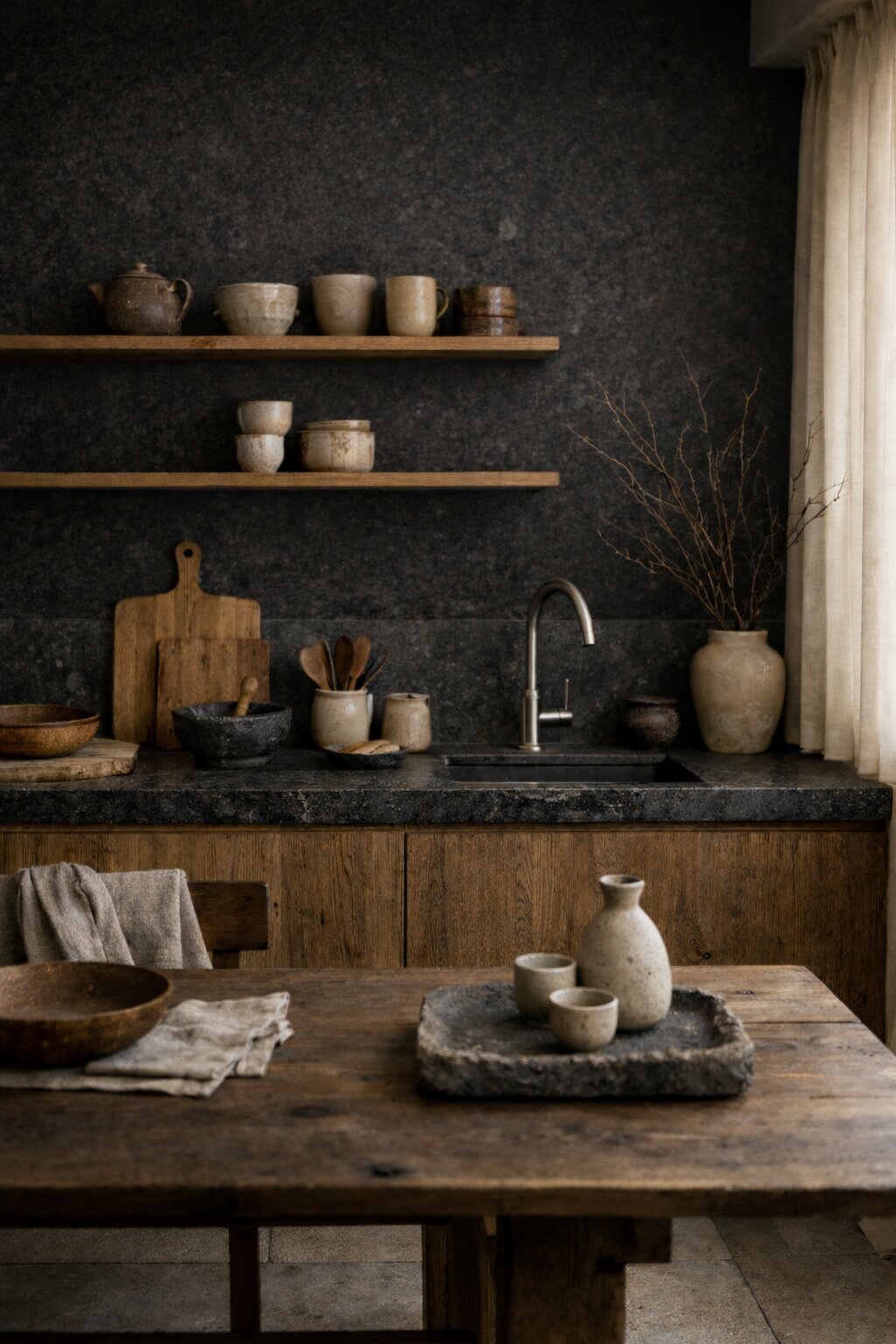
Wabi-sabi kitchen: Reclaimed wood cabinets with visible grain variation. Stone countertops showing natural veining and slight irregularities. Open shelving with handmade ceramics of varying shapes. A wooden cutting board permanently stationed on the counter, showing decades of knife marks.
Both are beautiful. But only the second invites you to use the kitchen without anxiety about marking it up.
Integrating Wabi-Sabi Into Daily Life & Interiors
Starting Point: The Mindset Shift
Before you change anything physical, you need to change your relationship with imperfection.
Try this exercise: Look around your current space and identify three things that annoy you because they’re imperfect—the scuff mark on the wall, the slightly mismatched chair, the worn spot on the rug. Now reframe each one as evidence of life lived. The scuff mark is from moving furniture to make space for gathering. The mismatched chair is the one that was actually comfortable enough to keep. The worn rug spot is where morning light invites you to stand with coffee.
This reframing is wabi-sabi in practice. You’re not ignoring problems or celebrating dysfunction—you’re distinguishing between damage that needs repair and character that tells your story.
Room-by-Room Application
Living Spaces: Creating the Sanctuary
What to keep:
- Furniture pieces with history, even if imperfect
- Books that are actually read, arranged by use rather than color
- Objects that serve a purpose or hold genuine meaning
- Natural light as the primary design element
- Textural layers through textiles and materials
What to release:
- Decorative objects purchased only for aesthetic effect
- Furniture that’s uncomfortable but “looks right”
- Anything you’re afraid to use or let others touch
- Excess pattern and visual complexity
- The pressure to have every surface styled
Specific implementations:
Walls: Consider lime wash or clay plaster instead of flat paint. These materials age beautifully, developing subtle patina and variation. They also regulate humidity naturally, improving air quality. If replastering isn’t feasible, choose warm whites or earth tones in matte finishes that won’t show every fingerprint as a crisis.
Seating: Prioritize comfort over matching. A vintage leather chair that’s developed patina alongside a linen sofa that wrinkles authentically creates more warmth than a perfectly matched suite. Add texture through wool throws, worn quilts, or naturally dyed cushions rather than decorative pillows that never move.
Lighting: Layer natural light, warm ambient light, and task lighting. Avoid overhead fixtures that create flat, shadowless spaces. Paper lanterns, handmade ceramic lamps, or aged brass fixtures create softer, more variable light that changes throughout the day.
Flooring: Wide-plank wood with visible grain and knots, natural stone with variation, or vintage rugs with worn spots all work. Avoid wall-to-wall carpet or overly uniform materials. If you have existing floors you can’t change, use natural fiber rugs (jute, sisal, wool) to add warmth and texture.
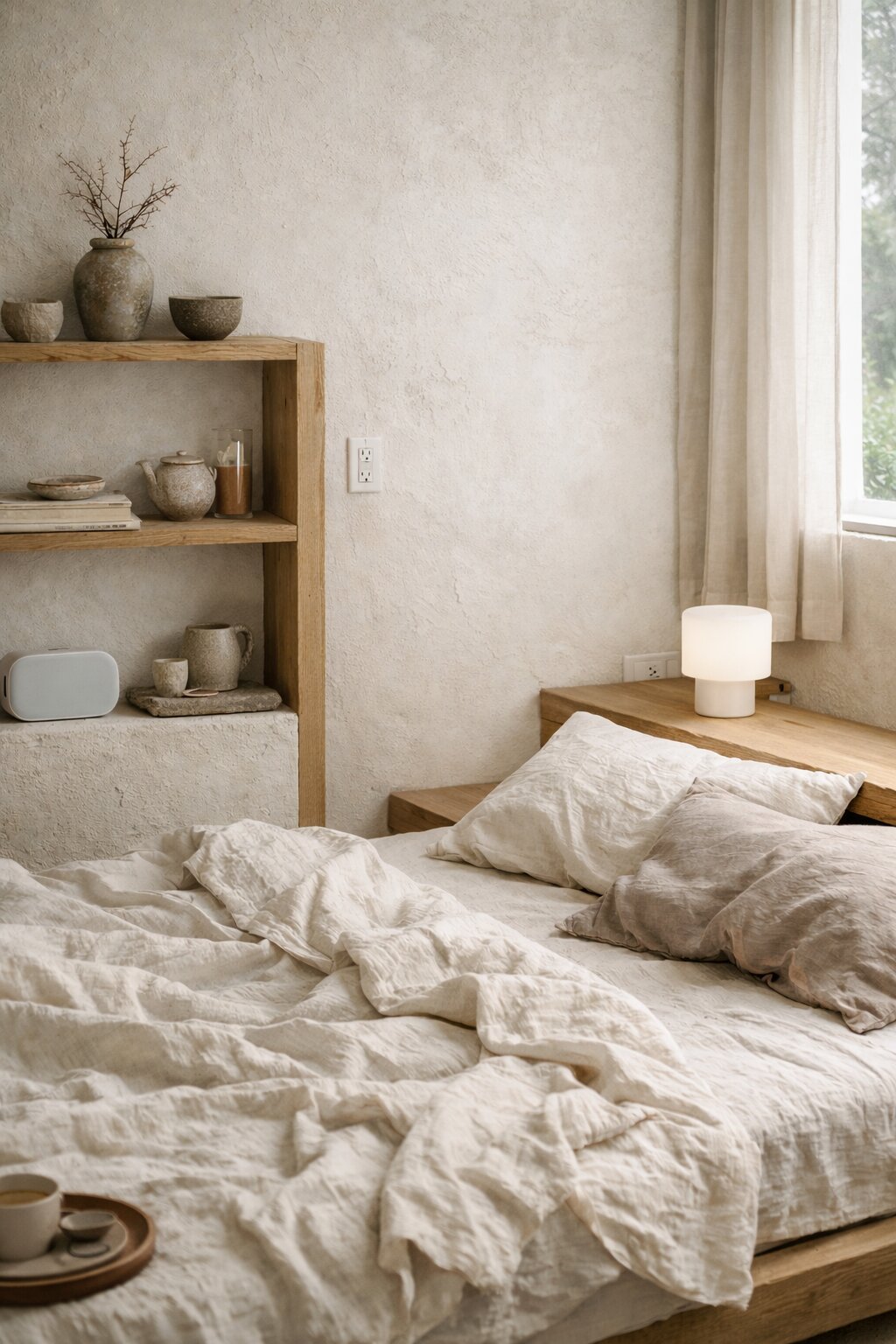
Bedrooms: The Rest Sanctuary
Your bedroom should be the most wabi-sabi space in your home—it’s where you’re most vulnerable, most in need of genuine calm.
Essential elements:
Bedding: Natural linen sheets that wrinkle beautifully. Avoid the hotel-perfect tucked corners—let linen drape naturally. Layer with wool or cotton blankets rather than synthetic comforters. The goal is material that feels good against skin and breathes naturally.
Color: Earth tones derived from clay, stone, sand, wood. These colors have been proven to lower cortisol levels because they signal safety and natural shelter. Avoid pure white (too clinical) or saturated colors (too stimulating).
Storage: Closed storage for most items, maintaining clear surfaces. But don’t hide everything—a stack of well-loved books, a wooden tray with daily jewelry, or a ceramic dish for small objects adds humanity without clutter.
Windows: Simple linen curtains or natural wood blinds. The goal is to filter light naturally while maintaining connection to outside. Blackout curtains and external world disconnection are useful for sleep but create a sealed-off feeling that counters wabi-sabi principles.
Kitchens: The Functional Heart
Kitchens present a challenge: they’re highly functional spaces with practical demands. Wabi-sabi here is about honest utility.
Countertops and surfaces: If renovating, choose materials that age rather than stain—soapstone, granite, or wood. These develop character. Sealed marble works if you accept that it will etch and patina. If you’re working with existing surfaces, add warmth through natural wood cutting boards, stone trivets, and ceramic containers.
Dish display: Open shelving with everyday ceramics creates more warmth than closed cabinets with hidden dishes. Choose handmade or vintage pieces that aren’t perfectly matched. The slight variation in glaze, shape, and size creates visual interest without chaos.
Patina zones: Designate areas that will naturally develop patina—a wooden countertop section for food prep, copper pans that will oxidize, a well-used cutting board. Don’t fight the natural aging; design with it.
The anti-kitchen-showroom principle: Your kitchen should look like someone cooks in it. A bowl of seasonal fruit, a crock of wooden spoons, a well-worn apron on a hook—these signs of use are wabi-sabi in action.
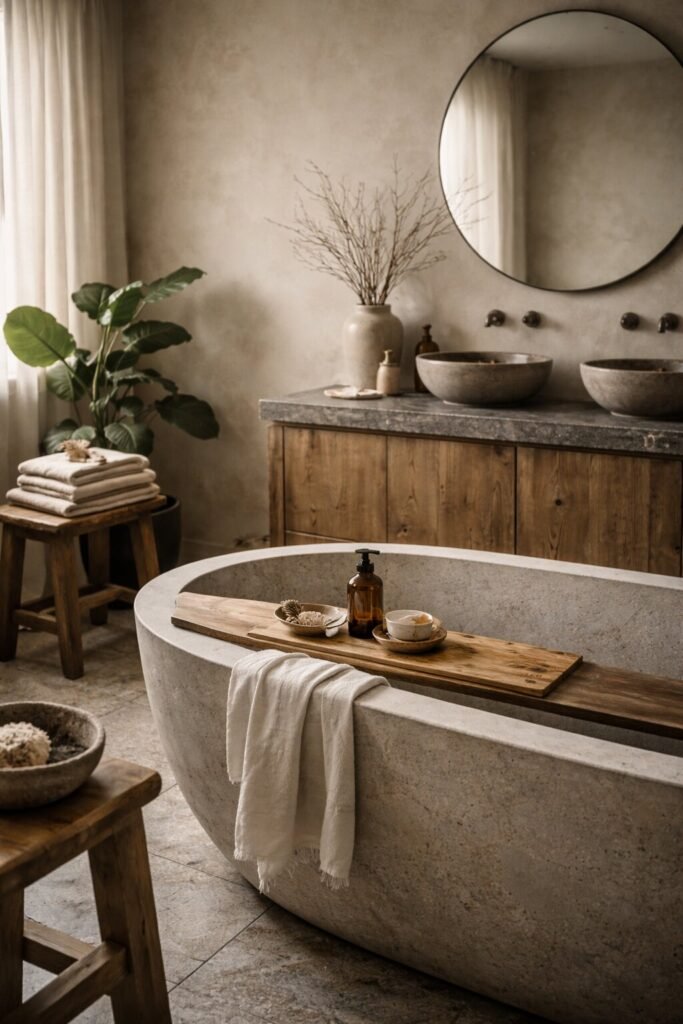
Bathrooms: The Cleansing Ritual
Bathrooms are where wabi-sabi meets hygiene, which requires careful balance.
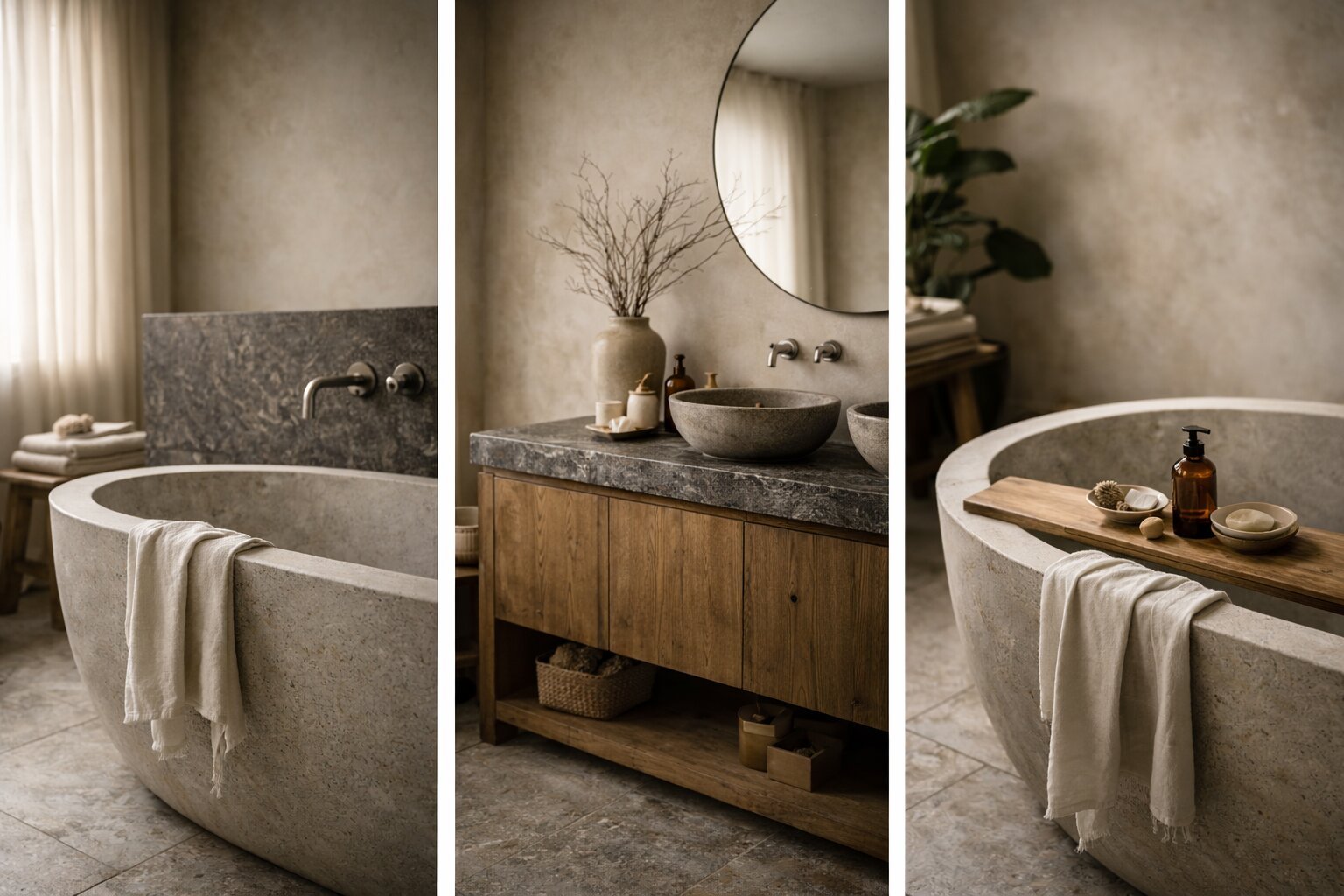
Materials: Stone, wood, and clay work beautifully if properly treated. Teak in wet areas, stone sinks that show natural variation, lime plaster walls that breathe. These materials handle moisture while maintaining natural character.
Simplification: Most bathrooms are cluttered with product bottles and styling tools. Store daily essentials in simple containers—ceramic jars, wooden boxes, glass vessels. Keep only what you actually use regularly.
The bathing experience: If you have a tub, make it a genuine sanctuary. A wooden bath tray, simple cotton towels, perhaps one plant that thrives in humidity. The goal is a space that invites slow, mindful presence rather than rushed efficiency.
Work Spaces: The Focused Environment
In 2025, most of us work from home at least part-time. These spaces need particular attention.
The clarity principle: Work spaces benefit from more simplicity than other areas. Clear desk surfaces, minimal visual distraction, natural materials that don’t compete for attention.
Natural elements: Position your desk near natural light. Add one plant—something slow-growing and forgiving like a snake plant or pothos. Use natural materials for desk accessories: wooden pen holders, stone paperweights, ceramic cups.
The imperfect archive: Don’t try to hide all work materials. A wooden shelf with well-organized books, a cabinet with supplies, or a basket with current projects acknowledges that work is part of life rather than something to completely conceal when the video call ends.
The Whole-Home Integration
Beyond individual rooms, wabi-sabi creates coherence through:
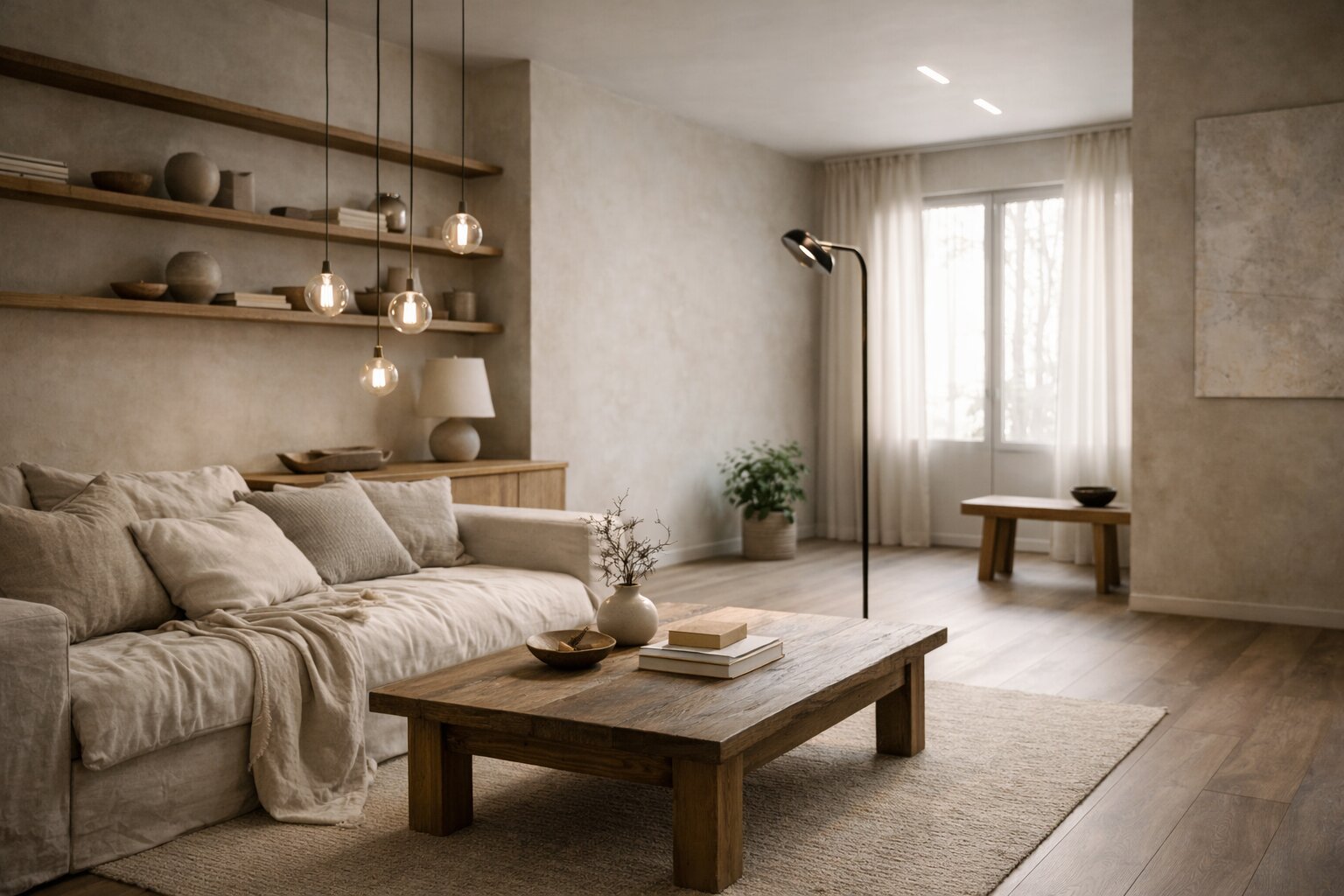
Material consistency: Use similar natural materials throughout—if you have wood floors, perhaps wood shelving and wood furniture frames. If you use stone in the kitchen, consider stone accents elsewhere. This creates visual flow without demanding identical styles in every room.
Transitional moments: Pay attention to thresholds and transitions. An entry space with a wooden bench and ceramic bowl for keys. A hallway with a single shelf displaying one rotating object. These moments slow you down and create mindful transitions between spaces.
Negative space as design: Don’t fill every corner. Allow empty walls, clear surfaces, and open floor space. This isn’t minimalism for aesthetics—it’s creating room for attention to rest.
The editing practice: Every few months, remove one object that no longer serves. This slow, continuous editing maintains simplicity without dramatic purges.
Practical Implementation: Moving from Theory to Reality
The 90-Day Transformation Roadmap
Wabi-sabi isn’t achieved through a weekend renovation. It develops through gradual, intentional change. Here’s a realistic timeline:
Month 1: Clearing and Observing
Week 1-2: Remove obvious excess. This isn’t minimalist purging—it’s removing things you don’t use, don’t like, or that create visual stress. Be honest about what you actually interact with versus what’s there “because it should be.”
Week 3-4: Live with the cleared space. Notice where your eyes rest, where you naturally gather, what you reach for daily. This observation period reveals what your space actually needs.
Month 2: Material Additions
Week 5-6: Add natural textiles. Replace synthetic curtains with linen. Add wool blankets. Swap polyester pillows for cotton or linen. These changes create immediate warmth and begin developing the textural layers that characterize wabi-sabi.
Week 7-8: Introduce handmade ceramics. Visit local pottery studios, craft fairs, or ceramic artists’ online shops. Choose pieces you’ll actually use—mugs, bowls, vases. The slight irregularities and visible maker’s marks begin shifting your aesthetic perception.
Month 3: Refinement and Patina
Week 9-10: Address lighting. Add paper lanterns, switch to warm bulbs, remove harsh overhead lighting where possible. Layer different light sources to create variation throughout the day.
Week 11-12: Begin the patina process. Stop fighting natural aging. Let wood breathe, let metals oxidize, allow materials to develop character. This is psychological as much as physical—you’re releasing the demand for perpetual newness.
Budget Realities: Wabi-Sabi Across Price Points
One of wabi-sabi’s great advantages: it doesn’t require luxury materials or high-end furniture. In fact, the philosophy actively resists status-driven consumption.
Low-budget approach ($500-2000):
- Thrift vintage wood furniture and leave it unfinished or oil it simply
- Paint walls with affordable matte paint in earth tones
- Invest in one set of quality linen bedding (buy seconds from linen makers)
- Source handmade ceramics from emerging artists on Etsy or Instagram
- Use natural fiber rugs from discount retailers
- Create art through framed natural materials or simple line drawings
Mid-budget approach ($2000-8000):
- Commission custom pieces from local woodworkers
- Apply lime wash or clay plaster to accent walls
- Invest in quality natural mattress and bedding
- Purchase established ceramic artists’ work
- Source vintage or antique furniture pieces
- Add architectural elements like wooden beams or stone accents
Higher-budget approach ($8000+):
- Custom millwork and cabinetry in natural wood
- Natural stone countertops and flooring
- Full lime plaster or tadelakt bathroom treatment
- Commission significant furniture pieces
- Architectural renovation incorporating natural materials
- Collaborate with artisans on integrated custom elements
The critical insight: Budget level doesn’t determine wabi-sabi success. A thrifted wooden table, honestly worn and oiled, embodies wabi-sabi more than an expensive designer table protected and maintained obsessively. The philosophy matters more than the price tag.
Common Mistakes and How to Avoid Them
Mistake 1: Artificial Distressing
Don’t buy furniture that’s been intentionally aged or distressed to look rustic. This is manufactured authenticity—the opposite of wabi-sabi. Instead, choose naturally aged vintage pieces or new items in honest materials that will develop patina through your use.
Mistake 2: Rustic Overload
Wabi-sabi isn’t farmhouse style. Piling on weathered wood, burlap, and Mason jars creates visual chaos, not calm. Each material should have space to express its character without competition.
Mistake 3: Dirty ≠ Wabi-Sabi
This is crucial: wabi-sabi is not about accepting dirt, disrepair, or dysfunction. A patinated copper sink is wabi-sabi. A sink covered in soap scum is neglect. The difference is whether the material is aging naturally and cleanly or deteriorating through lack of care.
Mistake 4: Copying Japanese Aesthetic Literally
You don’t need tatami mats, shoji screens, or zen gardens to practice wabi-sabi. These are specific cultural expressions. The principles translate across cultures, but the forms should adapt to your context.
Mistake 5: Aesthetic Without Philosophy
If you create a space that looks wabi-sabi but still stress about maintaining its perfection, you’ve missed the point entirely. The aesthetic should facilitate ease, not create new performance anxiety.
Maintenance and Evolution
Wabi-sabi spaces require different maintenance than conventional interiors:
Do maintain:
- Cleanliness and function
- Natural material treatments (oiling wood, sealing stone as appropriate)
- Structural integrity
- Comfortable functionality
Don’t maintain:
- Perfection of finish
- Pristine newness
- Exact color matching as things fade
- Concealment of all wear patterns
Allow to develop:
- Patina on metals
- Gentle fading of textiles
- Soft wear on wood surfaces
- Organic arrangement of objects
When to replace:
- When function fails completely
- When an object becomes genuinely unusable
- When something no longer serves your life
The maintenance philosophy: care for your space so it remains functional and beautiful, but don’t fight against the natural aging that gives it soul.
Deep Dive: The Psychology of Wabi-Sabi Environments
Why Imperfection Creates Calm: The Neuroscience
Research in environmental psychology reveals why wabi-sabi spaces produce measurable relaxation responses:
Cognitive load reduction: When environments contain too many perfect, uniform elements, our brains work harder to process the visual information. Natural variation—the kind present in organic materials and handmade objects—actually reduces cognitive load because it’s what our brains evolved to process. We’re hardwired to read natural patterns more efficiently than machine-generated perfection.
The mere exposure effect for natural materials: Studies show that exposure to natural materials like wood and stone activates parasympathetic nervous system responses—the “rest and digest” system. Synthetic materials don’t trigger the same response. When you touch wood or stone, your nervous system recognizes these as elements from ancestral environments where humans evolved.
Imperfection and self-compassion: Environments that embrace imperfection may actually increase self-compassion. When your home accepts flaws as part of its character, it creates psychological permission for you to accept your own imperfections. The opposite is also true: homes that demand perfection can increase anxiety and self-criticism.
Sensory richness through texture: Neuroscience research on sensory processing shows that textural variation—rough next to smooth, matte next to subtle sheen—creates more engaging but less stressful environments than either uniformity or high contrast. This is why wabi-sabi’s textural layering feels both interesting and calming.
The Control Paradox
Modern life offers us unprecedented control over our environments. We can set thermostats to precise temperatures, lighting to exact color temperatures, soundscapes through digital systems. Yet this control often increases rather than decreases anxiety.
Why? Because control creates the expectation of control. When everything should be perfect, anything imperfect becomes a problem requiring immediate fixing.
Wabi-sabi releases this burden. By designing environments that explicitly embrace impermanence and imperfection, you remove the expectation that everything should be controllable. This is profoundly liberating.
A wabi-sabi home asks: “What if the goal isn’t control but relationship?” You’re not managing a perfect environment—you’re living with a dynamic one that changes, ages, and responds to life.
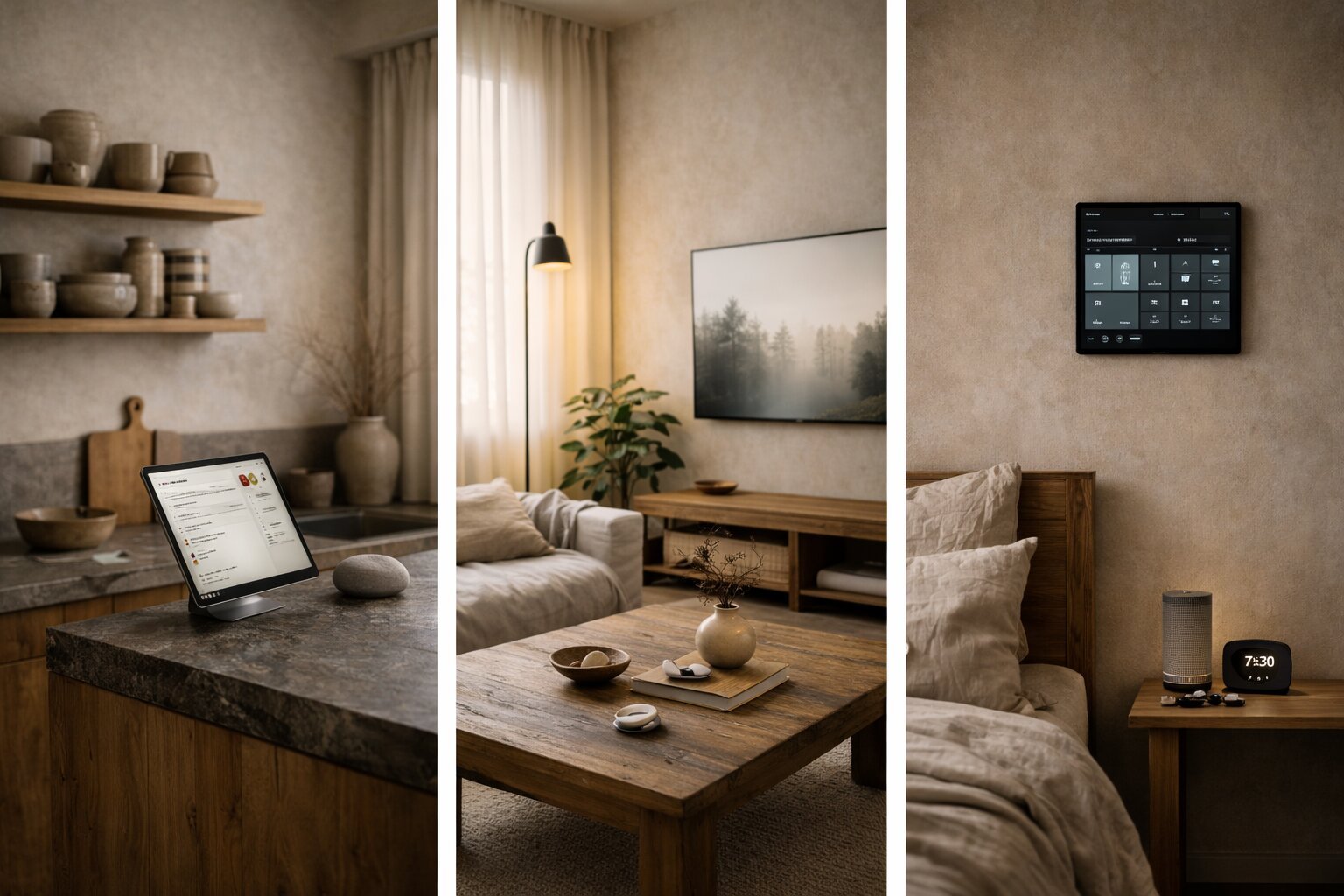
Wabi-Sabi as Digital Detox – but still using balance with tech
There’s a reason wabi-sabi resonates particularly strongly in 2025: it offers material counterpoint to our dematerialized digital lives.
Screens are perfect. Uniform. Backlit. They don’t age or develop character. Every Instagram feed looks similar. Every app interface follows the same design patterns. Digital spaces are essentially interchangeable.
Physical wabi-sabi spaces are the opposite. They’re specific, unique, unreproducible. They can’t be copied-and-pasted. They develop individual history. When you live in a space with genuine material character, you’re anchored in physical reality in a way that creates psychological balance against digital abstraction.
This isn’t anti-technology romanticism. It’s recognizing that humans need both digital capability and material connection, and that most of us are currently over-indexed on the former. we caneasily intergrate tech into our homes keeping the same principles at a heart
Wabi-Sabi and Sustainability: The Natural Alignment
Why Wabi-Sabi Is Inherently Sustainable
The principles that define wabi-sabi—natural materials, acceptance of aging, value for durability and craft—align perfectly with genuine sustainability:
Material longevity: When you choose objects that improve with age rather than deteriorate, you naturally extend their lifespan. A leather chair that develops patina over decades versus a bonded leather chair that cracks and peels in five years represents dramatically different environmental impact.
Anti-consumption philosophy: Wabi-sabi’s emphasis on simplicity and meaning directly counters consumption-driven design trends. You’re not replacing things because they’re out of style—you’re keeping things because they’ve developed character and continue to serve.
Local and natural materials: The preference for materials with minimal processing (untreated wood, natural fiber textiles, stone, clay) generally means lower embodied energy than highly processed alternatives.
Repair culture: When your aesthetic values patina and evidence of repair, you’re more likely to mend rather than replace. Visible darning in linen, wood furniture with butterfly joints showing repairs, re-tinned copper pots—these represent both wabi-sabi authenticity and radical sustainability.
The Greenwashing Problem
Be cautious: “wabi-sabi” is increasingly used to greenwash products that aren’t actually sustainable.
Red flags:
- Mass-produced “rustic” furniture from big-box retailers
- “Aged” finishes created through chemical distressing
- Cheap imported items marketed as “artisanal”
- Fast furniture brands using wabi-sabi aesthetic language
Genuine wabi-sabi sustainability:
- Truly handmade or small-batch production
- Materials sourced locally or regionally when possible
- Transparent production processes
- Items designed for decades of use, not seasonal trends
- Companies that support repair and restoration
Practical Sustainable Choices
Instead of buying new:
- Restore vintage wood furniture with natural oil
- Source vintage ceramics from estate sales and antique markets
- Commission repairs from local craftspeople
- Inherit or receive hand-me-downs and embrace their history
When buying new:
- Choose certified wood or reclaimed materials
- Support local artisans and makers
- Invest in quality that will last multiple decades
- Select natural, biodegradable materials over synthetics
The ultimate sustainability: Creating an environment you love enough to keep. The most sustainable object is the one you never replace because it continues to serve, to please, to feel like home.
Conclusion: Living the Philosophy
Wabi-sabi is not a design style to achieve. It’s a relationship with your environment to cultivate.
You can implement every material suggestion in this guide and still miss the essence if you’re maintaining perfection anxiety. Conversely, you can live in a rented apartment with laminate counters and IKEA furniture, yet practice genuine wabi-sabi through how you relate to these objects—using them fully, accepting their limitations, finding beauty in their honest service.
The invitation of wabi-sabi is simple but radical: What if your home didn’t have to be perfect to be beautiful? What if the marks of your life—the coffee ring on the table, the worn spot on the rug, the patina developing on that brass drawer pull—weren’t failures but autobiography?
In a culture that increasingly demands curation and performance, even in our private spaces, wabi-sabi offers permission to simply live. To use your things. To let time mark your environment. To create a home that’s a sanctuary precisely because it asks nothing of you except presence.
This is why wabi-sabi matters in 2025, and why it will continue to matter: not because it’s trendy, but because it’s true. It recognizes what we deeply need—spaces that allow rest, materials that connect us to the physical world, beauty that doesn’t demand constant maintenance.
The art of imperfection isn’t about lowering standards. It’s about realigning them toward what actually creates wellbeing: authenticity, warmth, ease, and the profound calm that comes from accepting rather than fighting the natural flow of time.
wanna know more about our mission to create homes that are sancturys get in contact
Wabi-sabi interior design is a Japanese-inspired philosophy that embraces imperfection, natural materials, and the beauty of ageing. Instead of striving for flawless, picture-perfect spaces, it focuses on creating calm, lived-in environments using organic textures like wood, stone, linen, and clay. The goal is to design a home that feels authentic, grounded, and meaningful rather than overly styled or artificial.
While both styles share minimalism and natural materials, wabi-sabi and Japandi differ in philosophy. Japandi focuses on clean lines, refined finishes, and carefully curated spaces, whereas wabi-sabi embraces irregularity, imperfection, and visible signs of age. Wabi-sabi feels more organic and lived-in, while Japandi leans toward polished and structured design.
The core principles of wabi-sabi interior design include simplicity, naturalness, and imperfection. This means using fewer but more meaningful objects, choosing materials that age beautifully like wood and stone, and allowing spaces to reflect real life rather than perfection. These principles help create a home that feels calm, balanced, and deeply personal.
You can achieve a wabi-sabi interior without spending a lot by focusing on natural and second-hand items. Choose vintage or thrifted furniture, incorporate linen or cotton textiles, and use handmade ceramics or decor. Avoid mass-produced “perfect” pieces and instead select items with character, texture, and slight imperfections that add warmth and authenticity to your space.
Wabi-sabi interiors feel calming because they reduce visual clutter and remove the pressure of perfection. Natural materials and soft textures help lower cognitive stress, while embracing imperfection allows you to relax in your space without constantly maintaining it. This creates a more peaceful, restorative environment that supports everyday wellbeing.